
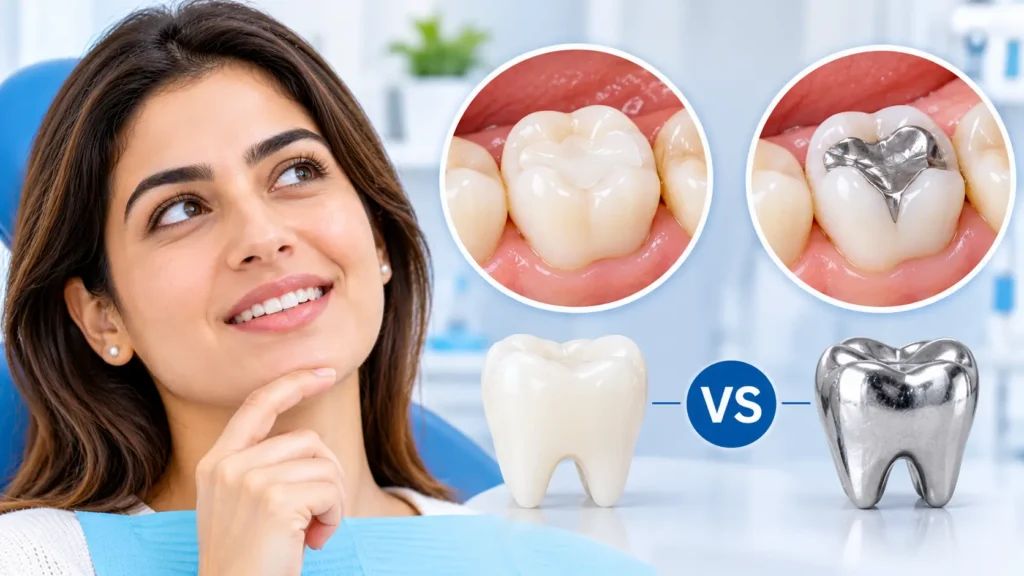
Cavity. It’s a word nobody loves hearing in the dental chair. And right after it, you often get a second question: do you want a white filling or a silver one? If you’ve never thought about it, that choice can feel oddly high-stakes. Is one better? Safer? Cheaper? Will anyone see it? This guide breaks down white fillings vs. silver fillings, so if you’re weighing tooth-colored fillings in Manchester, CT, or anywhere else, you’ll know what to ask and what actually matters.
What Are White Fillings and Silver Fillings Made Of?
Let’s start with the basics, because the names are a little misleading.
White fillings: Also called composite or tooth-colored fillings, these are made from a mix of plastic resin and fine glass or ceramic particles. The material is soft when it’s placed, shaped by your dentist, and then hardened with a special light. It can be matched to the shade of your natural tooth, which is why it’s so hard to spot.
Silver fillings: Also called amalgam fillings, these are made by combining a liquid metal (mercury) with a powder of metals like silver, tin, and copper. The result is a strong, durable material that’s been used in dentistry for well over a century. It’s silver-gray in color, and it darkens a bit over time.
Both materials fill the space left after decay is removed, and both can work well. They just go about it differently.
White Fillings vs Silver Fillings: How Do They Compare Side by Side?
Here’s a quick look at the factors people ask about most. These are general points, and your own tooth may point toward one option or the other.
- Appearance: White fillings blend in with your tooth. Silver fillings are noticeable, especially on teeth you can see when you smile.
- Durability: Amalgam is known for strength and often lasts a long time, especially in back teeth that handle heavy chewing. Composite has improved a lot and can last many years too, though it may wear sooner in some situations.
- Tooth preservation: Composite bonds directly to the tooth, which often means your dentist can remove less healthy tooth structure. Amalgam generally needs a bit more space to hold securely.
- Cost: Silver fillings tend to cost less, while white fillings often cost more. Prices vary by practice and by how large the filling is, so ask for an estimate.
- Time: White fillings can take a little longer to place, since the material is added in layers and hardened with a light. Silver fillings are often quicker.
- Sensitivity: Both can cause temporary sensitivity afterward. Amalgam can conduct heat and cold, which some people notice.
- Repair: Composite can often be repaired or added to. Amalgam may need to be replaced if it cracks.
Neither one wins every category, which is why this decision isn’t one-size-fits-all.
Are Silver Fillings Safe? What About the Mercury Question?
This is the part that makes a lot of people uneasy, so let’s talk about it calmly. Amalgam fillings do contain mercury, but it’s bound together with other metals into a stable material. Major dental and health organizations have reviewed the research, and they generally consider amalgam safe for most people.
That said, the U.S. Food and Drug Administration has noted that certain groups may want to talk with their dentist about alternatives, including pregnant women, nursing mothers, children under six, people with certain neurological conditions, people with kidney problems, and anyone with a known sensitivity to mercury. It’s not a reason to panic. It’s a reason to bring it up.
If the mercury question is weighing on you, you’re completely entitled to ask for a different material. Many people choose white fillings partly for that reason.
What Are the Pros and Cons of White Fillings?
Let’s look at each, starting with white fillings.
Pros:
- Natural look: They blend with your tooth, which is great for front teeth and visible spots.
- Conservative: They bond to the tooth, so your dentist may be able to keep more of your natural structure.
- Versatile: Besides fillings, composite can repair chips, close small gaps, and reshape teeth.
- Metal-free: A good fit for people who prefer to avoid metals.
Cons:
- Cost: They often cost more than amalgam.
- Wear: In large fillings on heavy-chewing teeth, composite may wear down or chip sooner.
- Staining: Over time, composite can pick up stains from coffee, tea, and red wine.
- Technique-sensitive: They need a dry, clean tooth to bond well, so placement takes care and time.
What Are the Pros and Cons of Silver Fillings?
And now, silver.
Pros:
- Strength: Amalgam holds up well under heavy chewing, which is why it’s often used on molars.
- Long track record: It’s been used for generations.
- Lower cost: It’s often more budget-friendly.
- Quick to place: Appointments can be shorter.
Cons:
- Looks: The silver color stands out, and the filling can darken over time.
- More tooth removal: Dentists may need to remove a bit more healthy tooth to hold the filling in place.
- Expansion and contraction: Amalgam can expand and contract with temperature changes, which in some cases may contribute to tiny cracks in the tooth.
- Mercury concerns: Some people prefer to avoid it, and certain groups may be advised to consider alternatives.
Which Is Better for Back Teeth vs Front Teeth?
Location matters a lot here. Front teeth are visible and don’t take as much force, so white fillings are usually the go-to choice. They look natural, and they blend in.
For back teeth, it’s more of a conversation. Molars handle serious chewing pressure, and amalgam has a reputation for standing up to it. But modern composites have gotten much stronger, and many dentists now use them on back teeth, too, especially for small to medium cavities. For very large cavities, your dentist may suggest a crown or another restoration instead. The right choice depends on the size of the cavity, how much tooth is left, and your bite.
Should You Replace Old Silver Fillings With White Ones?
Not automatically. If an old silver filling is intact and not causing problems, many dentists suggest leaving it alone. Removing a filling means drilling, which takes away some healthy tooth along with the old material, and it can add some risk of sensitivity.
There are good reasons to consider replacing one, though. It may be cracked, worn, leaking, or have decay forming beneath it. It might be causing a crack in the tooth. Or you may simply want a more natural look. If you’re thinking about it, ask your dentist to look at your fillings and explain what they see. If you’re considering replacing silver fillings with tooth-colored fillings in Manchester, CT, a quick exam can help you decide whether it’s worthwhile.
How Long Do White and Silver Fillings Last?
Nobody can give you an exact number. Amalgam fillings often last longer than composite ones, especially in back teeth, but it all depends. The size of the filling, where it sits, your bite, grinding habits, and how well you take care of the tooth all play a role.
The tooth around a filling can still get decay, so brushing twice a day, flossing, and regular checkups matter as much as the filling itself. If you grind your teeth, ask about a night guard. And if a filling ever feels rough, loose, or sensitive, call your dentist.
What Should You Ask Your Dentist About Fillings?
A few questions can make the conversation easier. Ask which material your dentist recommends for this tooth, and why. Ask how large the cavity is, and whether a filling is enough or a crown might be better. Ask what the cost difference will be, and whether insurance covers both types. And ask what to expect afterward, including any sensitivity.
It’s okay to ask for more than one option. A good dentist will walk you through the pros and cons and let you decide.
Ask About Tooth-Colored Fillings in Manchester, CT at Manchester Dental Arts
Choosing a filling shouldn’t feel like a pop quiz. If you’ve got a cavity, or you’re wondering whether to replace an old filling, a conversation is the best place to start. At Manchester Dental Arts, our team can take a look at your tooth, talk through white fillings vs silver fillings, and help you understand which option may suit your situation, with no pressure. If you’re exploring tooth-colored fillings in Manchester, CT, we’d be glad to answer your questions in plain language. Contact Manchester Dental Arts today to schedule a visit and learn more about your filling options in Manchester, CT.
White Fillings vs Silver Fillings FAQs
Are white fillings as strong as silver fillings?
Modern composite fillings are strong and work well for many cavities, but silver fillings may hold up better in very large fillings on heavy-chewing teeth. Your dentist can advise based on your tooth.
Do white fillings cost more than silver fillings?
Often, yes. Costs vary by practice and filling size, so ask for an estimate before you decide.
Is it safe to have silver fillings?
Major dental and health organizations consider amalgam safe for most people, though certain groups may want to talk with their dentist about alternatives. If you’re concerned, ask about other materials.
Does insurance cover white fillings?
Many plans cover white fillings, sometimes at the same level as silver, and sometimes with a lower payment for composite on back teeth. Coverage varies, so check your plan.
Do white fillings stain?
They can pick up stains over time, especially from coffee, tea, and tobacco. Good brushing and regular cleanings help keep them looking fresh.