
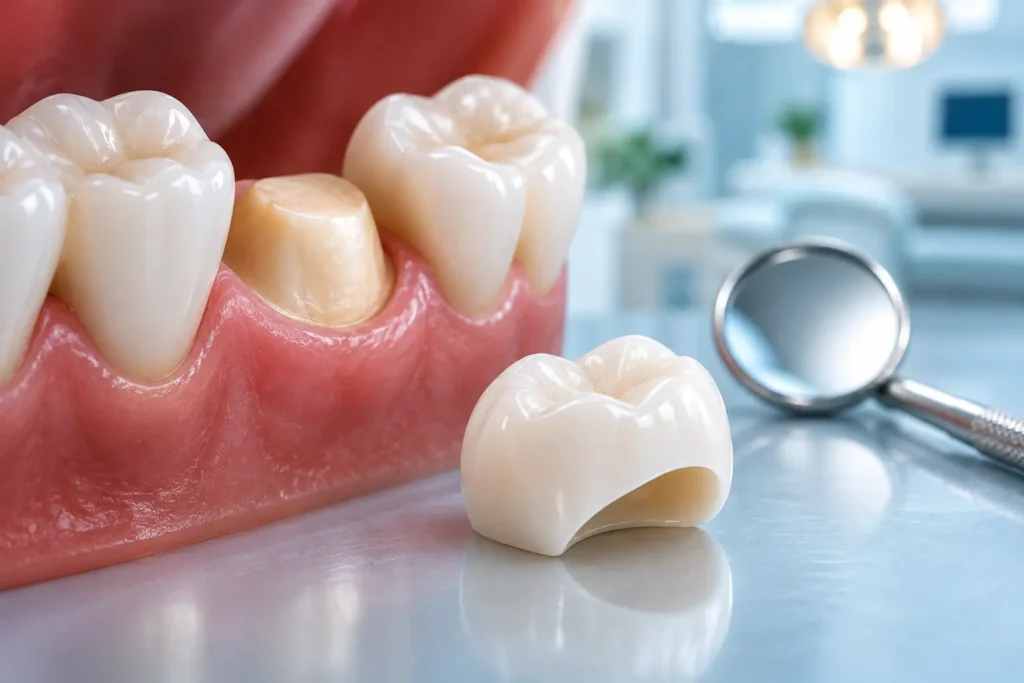
You bite into something chewy, and suddenly there is a hard little object in your mouth and a rough, sensitive tooth where your crown used to be. It is an unsettling moment, but a crown that comes off is a common problem and usually one that can be fixed.
What you do in the next few hours and days makes a real difference. Here is what to do if a crown comes loose or falls out, what to avoid, and what happens when you come to see us at Manchester Dental Arts in Manchester, CT.
What Should You Do First When a Crown Falls Off?
Try to stay calm and work through these steps:
- Keep the crown. Take it out of your mouth carefully so you do not swallow it, and do not throw it away. In many cases it can be cleaned and placed back on the tooth if it is undamaged and the tooth underneath is healthy.
- Rinse gently. Use warm water to rinse your mouth and clean the crown. Do not scrub it with strong cleaners.
- Look at the tooth. Check whether the tooth underneath looks cracked or chipped, or whether there is a lot of pain. This helps us when you call.
- Call the office. Phone us at (860) 643-0688 so we can find the earliest suitable time to see you. Bring the crown with you in a clean container.
The sooner a crown is looked at, the better. An uncovered tooth is more exposed to sensitivity, bacteria and further damage, and the neighbouring teeth can begin to shift if the gap is left for a long time.
How Can You Protect the Tooth Until Your Visit?
While you wait for your appointment, a few simple precautions will help:
- Chew on the opposite side of your mouth.
- Choose softer foods and avoid anything sticky, hard or very hot or cold.
- Keep brushing gently around the area and keep it clean. Food and plaque can collect easily where the crown used to sit.
- Take an over-the-counter pain reliever as directed on the label if the tooth is sore, and speak with a pharmacist if you are unsure what is suitable for you.
- Rinse with warm salt water if the gum feels tender.
Some people place the crown back temporarily with a dental product designed for that purpose, which is sold at many pharmacies. This is only a short-term measure, and it should never be treated as a repair. Please do not use household glue or any other adhesive that is not intended for teeth. It can damage the crown and tooth and make a proper repair harder.
Why Do Crowns Come Off?
A crown is held in place by dental cement, and several things can weaken that bond:
- Decay under the crown. If a cavity develops at the edge of the crown or in the tooth beneath it, the crown may no longer fit snugly.
- Biting on hard or sticky food. Hard sweets, ice and very chewy foods put a lot of pressure on a crown.
- Heavy bite forces. Clenching or grinding your teeth can loosen a crown over time.
- Wear and age. Crown lifespan depends on hygiene, bite forces, tooth location and care, so a crown that has been in place for a long time may eventually loosen.
- Too little healthy tooth structure. If the tooth under the crown has cracked or weakened, the crown has less to hold on to.
- Poor fit. A crown that does not fit the tooth well can allow bacteria to creep underneath.
Knowing the cause matters, because simply recementing a crown will not solve a problem that is still there. If decay is the issue, for example, it needs to be treated first.
What Will the Dentist Do?
When you come in, we start with an examination of the crown and the tooth. X-rays may be taken to look for decay or damage beneath the surface. If the crown is intact and the tooth is healthy, we may be able to clean both and bond the crown back in place after checking the fit and bite.
If the crown is damaged, no longer fits, or the tooth has decay or a crack, we will talk through the options with you. These may include treating the decay first and making a new crown. In some cases a tooth that is badly damaged needs further treatment such as a root canal before it can be restored, or we may discuss other ways to replace it.
For a new crown, the usual steps are:
- An examination and treatment plan.
- Preparing the tooth.
- Taking an impression or digital scan.
- Placing a temporary restoration when appropriate.
- Fitting the final crown and checking the fit and bite.
You can read more about the process on our crowns and bridges page. If you are unsure whether a crown or another restoration suits your situation, our guide comparing crowns and bridges explains the difference.
What If It Is a Temporary Crown?
Temporary crowns are designed to stay in place for a short time while your permanent crown is made, and they are held with a weaker cement. They can come off more easily, particularly if you eat something sticky. The advice is the same: keep the crown, protect the tooth and call us. Leaving the tooth without cover for long can make it sensitive and can affect how your final crown fits.
How Can You Keep a Crown in Place for Longer?
- Brush twice a day and clean between your teeth daily. Bridges need special attention underneath and around them.
- Keep up regular cleanings and exams so any decay near a crown is found early.
- Avoid chewing ice, pens, hard sweets or other hard objects.
- Be careful with very sticky foods, particularly with a temporary crown.
- Tell us if you clench or grind your teeth, because this can loosen a crown.
- Call us if a crown ever feels loose. Catching a loose crown early may mean it can be fixed without major work.
Why Choose Manchester Dental Arts for Crown Care?
Patients tell us they appreciate how carefully we explain what is happening and keep them comfortable throughout treatment. We look for the reason a crown came off rather than just putting it back, so the fix lasts. Dr. Shah’s approach is that the best dentistry is the least amount of dentistry, so we always aim to protect as much of your natural tooth as we can.
Call Us if Your Crown Has Come Off
A crown that has fallen out is worth dealing with promptly. Call (860) 643-0688 or contact us online to arrange a visit at 229 E Center St, Manchester, CT. Our hours are Monday to Friday, 8 am to 5 pm. Please bring the crown with you.
Frequently Asked Questions About Crowns That Come Off
Is a crown falling off a dental emergency?
It usually needs prompt attention rather than being a crisis, but you should call us as soon as you can. If you have severe pain, swelling or fever, tell us when you call so we can plan accordingly.
Can I put my crown back on myself?
A temporary dental product bought from a pharmacy may hold it for a short time, but it is not a fix. Never use household glue. Bring the crown in so it can be properly checked and re-bonded if suitable.
Can the same crown always be reused?
Not always. If the crown is undamaged and the tooth underneath is healthy, it may be possible to bond it back. If the tooth has decay or has changed, or the crown no longer fits, a new crown may be needed.
Will the exposed tooth be painful?
It can be sensitive to air, temperature and biting, because the protective covering is gone. Soft foods and chewing on the other side can help until your visit.
What if I swallowed the crown?
A swallowed crown usually passes through the digestive system without trouble. Let us know, and contact a doctor straight away if you have trouble breathing, chest pain or abdominal pain.
How long should a crown last?
A crown has no guaranteed lifespan. How long it lasts depends on your hygiene, bite forces, the location of the tooth and how well you look after it. Regular check-ups help us notice problems early.