
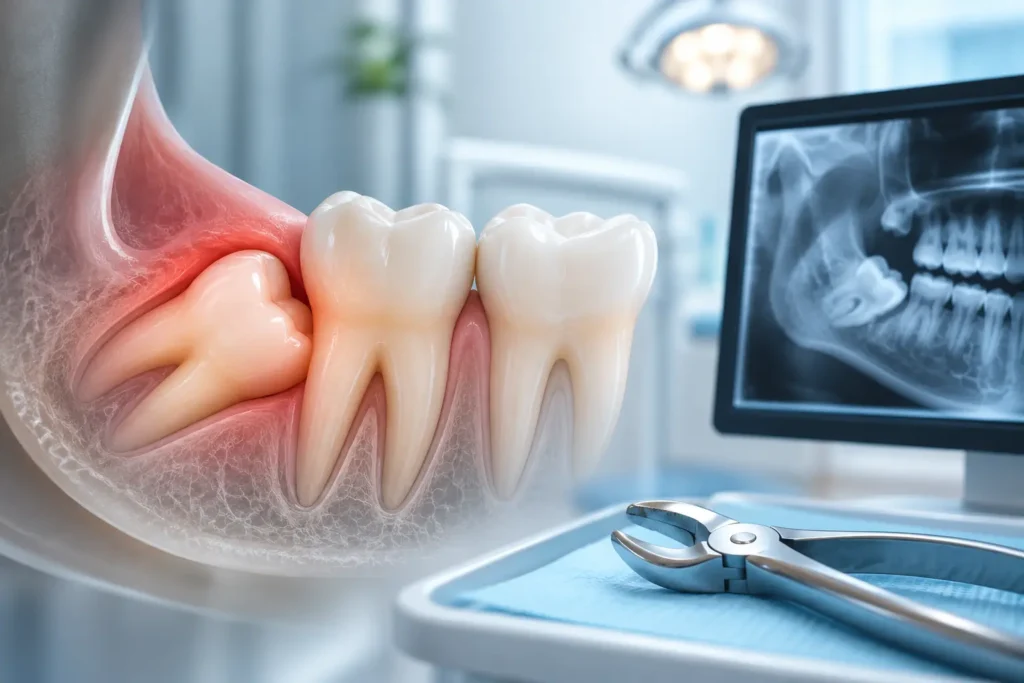
Wisdom teeth are the last to arrive, usually somewhere in the late teens or twenties, and they often do not have enough room. When there is not enough space, a wisdom tooth can come in at an angle, stay partly under the gum or remain trapped in the jaw. Dentists call this an impacted wisdom tooth.
Some impacted teeth cause no trouble at all, while others cause pain, infection or damage to neighbouring teeth. This guide explains how to recognise a wisdom tooth growing sideways, what problems it can cause, how we decide whether it needs to come out and what to expect if it does. If you live in or around Manchester, CT, we are here to help you work out the best next step.
What Is an Impacted Wisdom Tooth?
A tooth is impacted when it cannot fully come through the gum into its normal position. With wisdom teeth, this is common because they are at the very back of the mouth, where space can be limited after the other teeth have already settled.
Impacted teeth are described by the way they sit:
- Angled toward the tooth in front. The wisdom tooth leans forward and presses against the second molar.
- Angled toward the back of the mouth. The tooth tilts away from the other teeth.
- Horizontal, or sideways. The tooth lies flat in the jaw, pointing toward the neighbouring tooth.
- Vertical but trapped. The tooth is upright but stays below the gum or below the bone.
- Partially erupted. Part of the crown shows through the gum, while the rest stays covered.
A tooth does not have to be sideways to be a problem. Even one that is only partly through the gum can cause trouble, because the flap of gum over it is hard to keep clean.
What Are the Signs That a Wisdom Tooth Is Impacted?
Many impacted wisdom teeth are found on an X-ray before you notice anything. When symptoms do occur, they may include:
- Pain or tenderness at the back of the jaw.
- Red, swollen or bleeding gums around the back tooth.
- A bad taste or bad breath that does not go away with brushing.
- Difficulty opening your mouth fully or pain when you chew.
- Swelling around the jaw or cheek.
- A headache or jaw ache that seems to start from the back of your mouth.
- Tenderness in the tooth in front of the wisdom tooth.
Symptoms can come and go. A wisdom tooth that settles down for a few weeks may flare up again later, so it is worth getting it checked instead of waiting to see what happens.
Why Can an Impacted Wisdom Tooth Cause Problems?
When a wisdom tooth is stuck or at an angle, several things can happen:
- Gum infection. A partly covered tooth leaves a small pocket where bacteria and food collect. This can lead to painful swelling and infection of the gum around the tooth.
- Decay. A wisdom tooth leaning against the second molar can trap food and plaque in a place that is very hard to clean, putting both teeth at risk of cavities.
- Damage to the neighbouring tooth. Pressure from the angled tooth can harm the tooth in front of it.
- Gum disease. Hard-to-clean areas at the back of the mouth are more likely to develop gum problems.
- Cysts. Occasionally a fluid-filled sac can form around a tooth that is trapped in the jaw.
Not every impacted tooth leads to these problems, and a tooth that is not causing trouble can sometimes be monitored. That is why a proper examination matters.
How Do We Diagnose an Impacted Wisdom Tooth?
We start with a conversation about your symptoms and an examination of the area. X-rays are usually recommended, because an impacted tooth cannot be fully assessed by looking at your gums. The X-ray shows the angle of the tooth, how deep it sits, how close it is to the neighbouring tooth and the surrounding bone.
With that information, we can talk about whether the tooth should be watched, treated for an infection or removed.
Does an Impacted Wisdom Tooth Always Need to Be Removed?
No. Whether to remove a wisdom tooth depends on what it is doing and what is likely to happen next. Removal is more likely to be recommended when:
- The tooth keeps becoming painful or infected.
- It is damaging or decaying the tooth next to it.
- There is a cyst or other change in the surrounding bone.
- It cannot be cleaned and is causing gum disease.
- It is positioned in a way that is likely to cause problems later.
If the tooth is not causing symptoms and is not harming anything nearby, we may suggest keeping an eye on it with regular check-ups and X-rays. Our tooth extraction page explains when extraction is considered, including certain wisdom teeth, and we may talk through alternatives first where they make sense.
What Happens When an Impacted Wisdom Tooth Is Removed?
Before treatment, we examine the area, review your X-rays and explain what to expect. Local anesthesia numbs the area, so you should not feel pain during the procedure, although you may feel pressure or movement. If you feel discomfort, tell us straight away.
A tooth that is fully through the gum is usually removed with a simple extraction. An impacted tooth is more likely to need a surgical extraction, which is used for teeth that are broken, hard to reach or not fully erupted. This can involve gently opening the gum and, in some cases, sectioning the tooth so it can be removed in smaller pieces. Surgical extractions typically involve more swelling and soreness afterward than simple ones.
If you are nervous, please tell us beforehand. We can explain the anesthesia choices and what to expect. If you may have a type of anesthesia or sedation that affects driving, ask about transportation in advance, since whether you can drive home depends on what is used.
What Is Recovery Like After Wisdom Tooth Removal?
Initial healing happens over several days, while deeper tissue and bone take longer. Swelling is commonly worst around the second day, and the worst of the discomfort usually eases by day three or four. Full soft-tissue healing generally takes a week or two.
The most important thing you can do is protect the blood clot that forms in the socket. In short:
- Do not rinse hard, spit forcefully, use a straw or smoke for at least the first day.
- Use an ice pack on the outside of your cheek in short intervals during the first day.
- Eat soft, cool foods such as yogurt, applesauce, mashed potatoes and scrambled eggs.
- Take pain medication only as directed.
- Start gentle warm salt-water rinses after the first day.
Our detailed guide to tooth extraction aftercare in the first 48 hours walks through each stage in more detail.
Contact us if you notice pain that gets worse after the second day, bleeding that does not slow with firm pressure on gauze, swelling or fever that keeps increasing, a persistent bad taste or smell, or a socket that looks empty with bone showing. These can be signs of a problem such as dry socket or infection.
What If I Wait and Do Nothing?
Sometimes waiting is reasonable, but only after a dentist has looked at the tooth. A wisdom tooth that is causing recurring gum infections, decay or damage tends not to settle by itself, and problems can build up quietly because the area is so hard to see and clean. Treating a problem earlier is often simpler than dealing with an advanced infection or damage to a second tooth.
If you are not sure whether your tooth is causing problems, a quick examination and X-ray can give you a clear answer.
Why Choose Manchester Dental Arts?
We start with listening and looking carefully before recommending anything. Our approach is to explain what is happening in plain language, give you the options and only suggest treatment you actually need. Patients often mention how calm and thorough Dr. Shah is and how well he explains each step.
Have Your Wisdom Teeth Checked in Manchester, CT
If you have pain at the back of your jaw, swollen gums, or a wisdom tooth you suspect is coming in at an angle, we can examine it and explain your options. Call (860) 643-0688 or book an appointment online. We are at 229 E Center St, Manchester, CT, open Monday to Friday, 8 am to 5 pm.
Frequently Asked Questions About Impacted Wisdom Teeth
How do I know if my wisdom tooth is growing sideways?
You usually cannot tell from symptoms alone. Pain, swollen gums and a bad taste at the back of your mouth are common signs, but the angle of the tooth only shows on an X-ray, which we can take at an examination.
Is removing an impacted wisdom tooth painful?
The area is numbed with local anesthesia, so you should not feel pain during the procedure, only pressure or movement. Soreness and swelling afterward are normal, especially after a surgical extraction.
How long does it take to recover?
Initial healing takes several days, with swelling usually worst around day two. Soft tissues generally heal within one to two weeks, while deeper tissue and bone take longer.
Can an impacted wisdom tooth go away on its own?
No. An impacted tooth will not move out of the jaw by itself. Some stay quiet for years and are simply monitored, while others cause problems and need to be removed.
Do all wisdom teeth have to come out?
No. A wisdom tooth that is healthy, fully through the gum, easy to clean and not causing problems may not need to be removed. We look at each tooth individually.
What can I eat after wisdom tooth removal?
Start with soft, cool foods such as yogurt, applesauce, mashed potatoes and scrambled eggs. Avoid hard, crunchy, sticky or very hot foods, and avoid straws, until your dentist says you can return to normal eating.
When should I call after a wisdom tooth extraction?
Call if pain worsens after the second day, if bleeding continues despite firm gauze pressure, if swelling or fever increases, or if you notice a bad taste or an empty-looking socket.